We understand the need for supplying specialist nutracines to help maintain the structure and physiology of the joints and associated bone, cartilage and tendon. Joint degradation can occur due to one of two main reasons; wear and tear can occur simply as a function of age, or it can be caused by mechanical damage due to enhanced activity.
What we are also beginning to understand is what also happens to muscle and merely increasing protein intake is not the most efficient route to supporting muscular activity.
All cells contain protein in some form and the makeup depends on the type of cell. Even muscle cells vary between the types – smooth, cardiac and voluntary – as does the impact of normal processes affect their maintenance. For example, the abrasive effect of food passing along the gut, wearing down the absorptive surfaces, means massive regeneration and the gut wall has the largest need for dietary protein.
The voluntary, or striated, muscles also suffer from high levels of wear. We are probably all aware of the “ratchet” mechanism of muscle contraction, where muscle fibres slide over each over, but it does have certain limitations. Foremost is the conversion of a biochemical process (energy generation in the form of ATP) into a mechanical result, and it is accompanied by the generation of ultrastructural damage and the release of oxidative free radicals.
In line with all metabolic processes there is a balance between anabolism (building) and catabolism (breakdown). Normal levels of activity are within the natural constraints and muscle wear is matched by regeneration.
However, there is a biochemical and physiological process to muscle damage. Muscular activity induces protein breakdown and the release of inflammatory markers and immunomodulatory cues which mop up damaged particles. At the same time, oxidative free radicals and enzymes continue the process of protein breakdown.
Countering this is the process of protein deposition and tissue repair. It is initiated by an increase of vascular activity (blood supply) to the site of damage; not only will this improve the oxygen supply, which is beneficial for energy metabolism especially in slow twitch muscle fibres, but increase the relevant nutrients and metabolites needed for muscle regeneration.
There are two aspects to muscle repair, whilst protein deposition would seem the most obvious, lipid metabolism is essential. Muscle fibres are, in the main, protein strands, but are encased in a protein/lipid complex cell membrane and it is the chemical properties of the both the neutral lipids and the phospholipids that allow the strands to slide over each other; giving rise to contraction.
Both vascular development and cell membrane lipids benefit from Omega-6 and Omega-3 fatty acids. Although Omega-6 is sometimes regarded as being pro-inflammatory (it is actually anti-inflammatory but less so than omega-3), it is also a critical component in improving vascular flow. Omega-3 fatty acids are important in maintaining the neutral and phospho-lipids in the cell membrane.
Following on from the inflammatory phase of muscle degradation – when activity slows or stops – there is a phase of proliferation; proteolysis is reversed and the inflammatory cytokines promote collagen synthesis. This is initiated in the presence of the amino acid leucine, one of the branched amino acids that also include isoleucine and valine, and arginine also aids muscle development and vascular development.
In order to modulate muscle repair – over-proliferation can lead to muscle scarring, which is beneficial in wound healing – it is necessary to limit the pro-inflammatory phase, by promoting anti-inflammation and reducing oxidation. Antioxidant vitamins have been implicated in muscle integrity and tissue repair. Vitamin A improves muscle mass and reduces fat marbling, vitamins B, D, and biotin can help reduce proteolysis and vitamin C has been shown to moderate collagen synthesis.
Vitamin E has long been known as an effective antioxidant, but also reduces those enzymes associated with protein breakdown.
Trace elements are also associated with reduced muscle damage, especially selenium, manganese and magnesium.
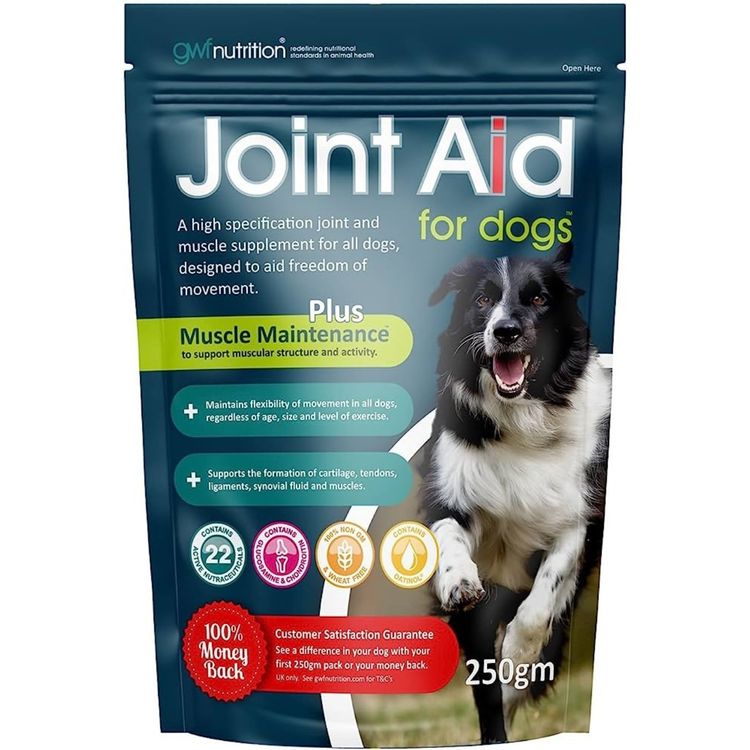
Many of the components of Joint Aid will help support normal muscle dynamics. Some anti-inflammatory and antioxidant components are common to both joint and muscle physiology, as are collagen and chondroitin. Although more associated with cartilage metabolism, chondroitin helps modulate tissue regeneration and collagen makes up about 10% of regenerated muscle.
However, positive metabolites will enable a dynamic turnover of muscle metabolism, helping ameliorate the inflammatory phase and regulate proliferation. Specific antioxidants and trace elements have been added and the new product has been formulated to increase its levels of leucine, arginine and the branched chain amino acids.
By introducing these nutrients to the existing nutracines of Joint Aid, there are complementary antioxidant and anti-inflammatory support, beneficial omega-6:3 ratios and an amino acid profile suited to voluntary muscle.